
01
Ask a persona
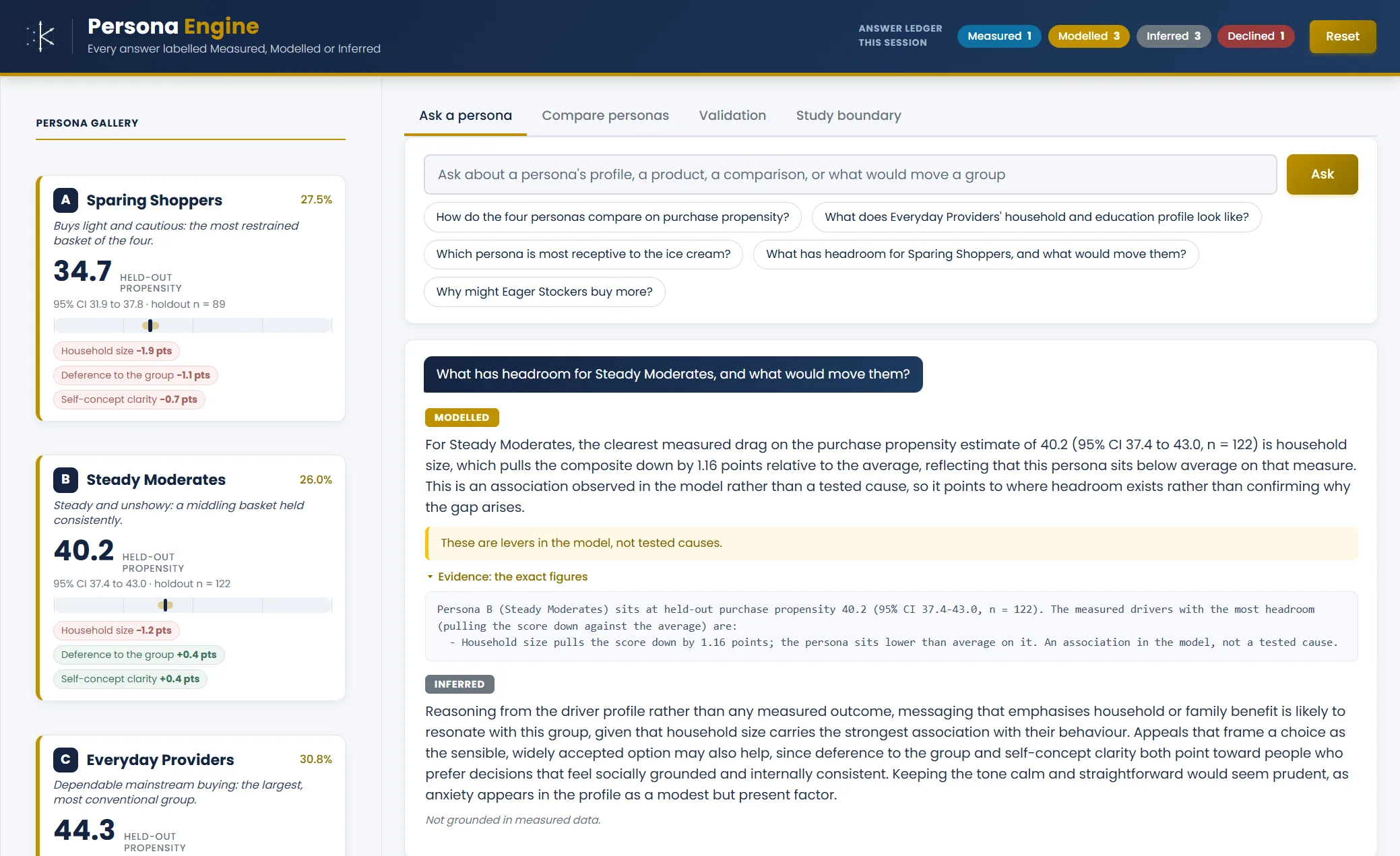
Type a question in plain language. The answer comes back in labelled parts, so you can see what is read from the data and what is the engine's judgement.
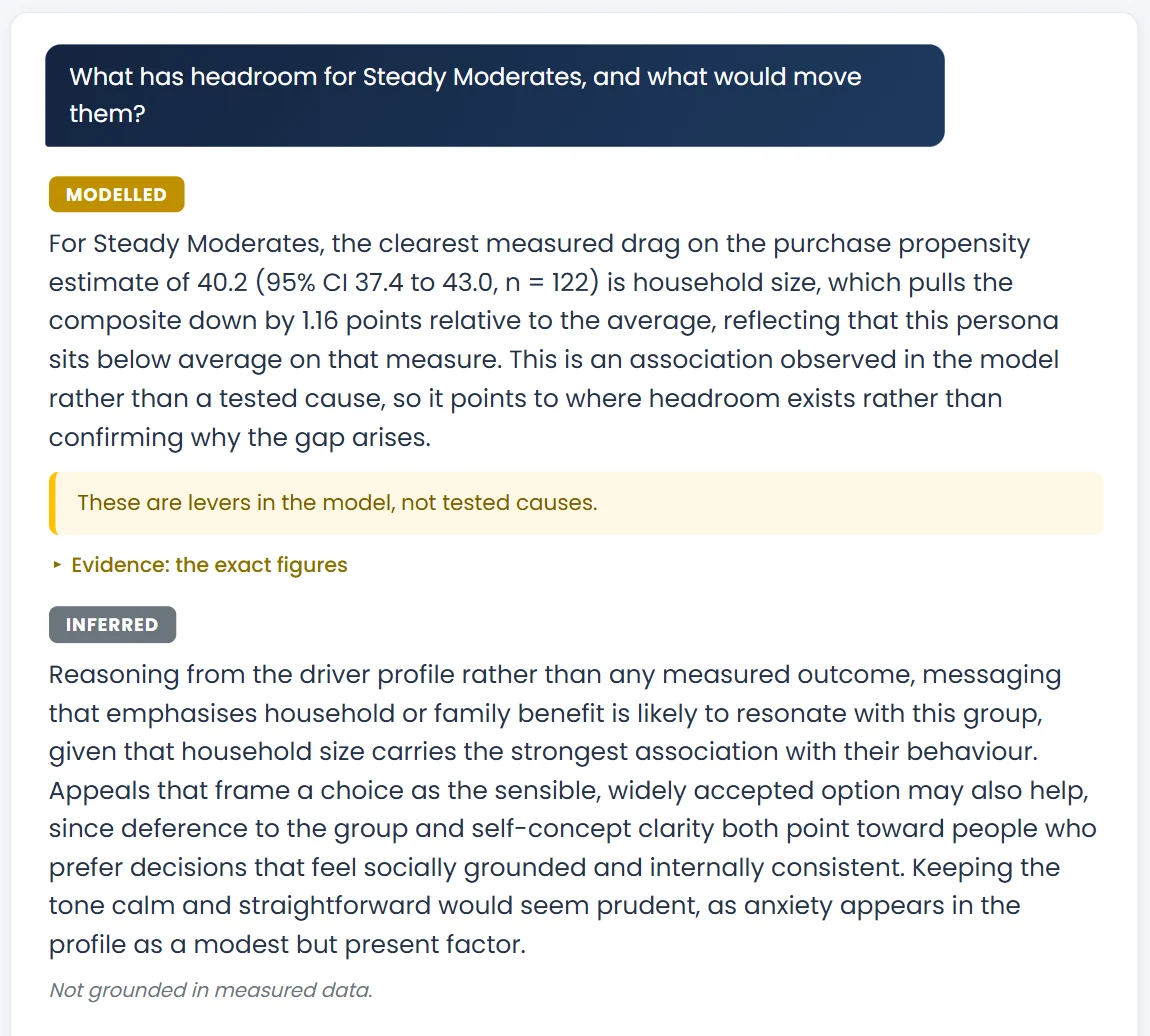
Most persona tools animate the segmentation you already have. The Persona Engine builds the personas first, from what drives the outcome you care about, then lets your team question them: how a group would react to an idea, what would win it over, what the brief should say. Every figure comes from validated analysis. Every answer says whether it was measured, modelled or inferred.
When the data cannot answer, it says so.
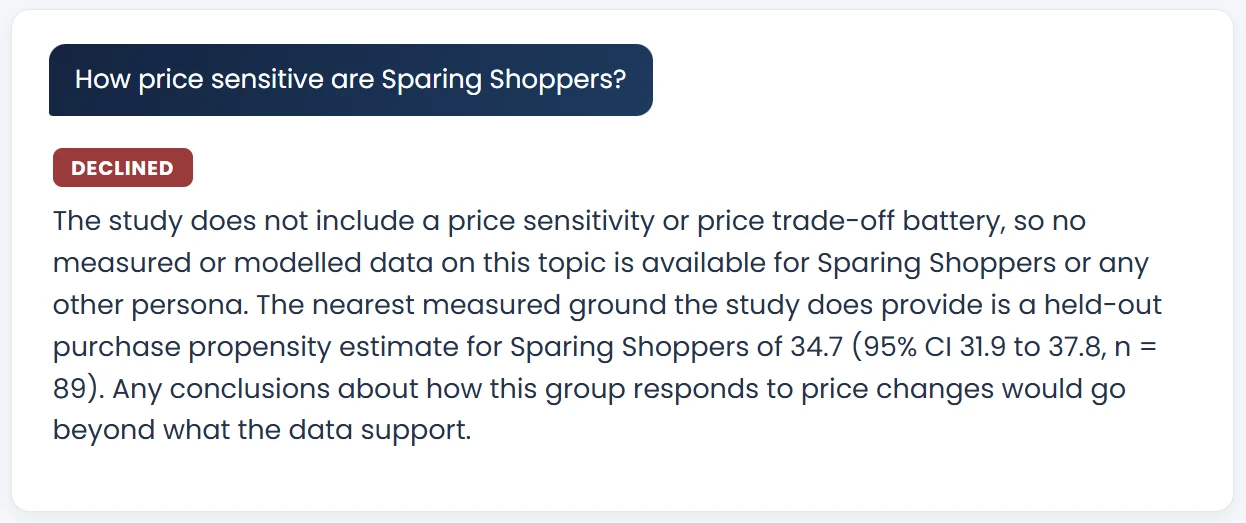
Four personas built from Columbia's public Twin-2K-500 dataset, each speaking only what the data measured or the model predicted, and one of them declining to answer.
Our demonstration, built on a public dataset of 2,058 US consumers. We run it live on calls, so you can put your own questions to it.
Type a question in plain language. The answer comes back in labelled parts, so you can see what is read from the data and what is the engine's judgement.
Open Evidence under any answer to see the exact figures, how many people they rest on, and where they came from.
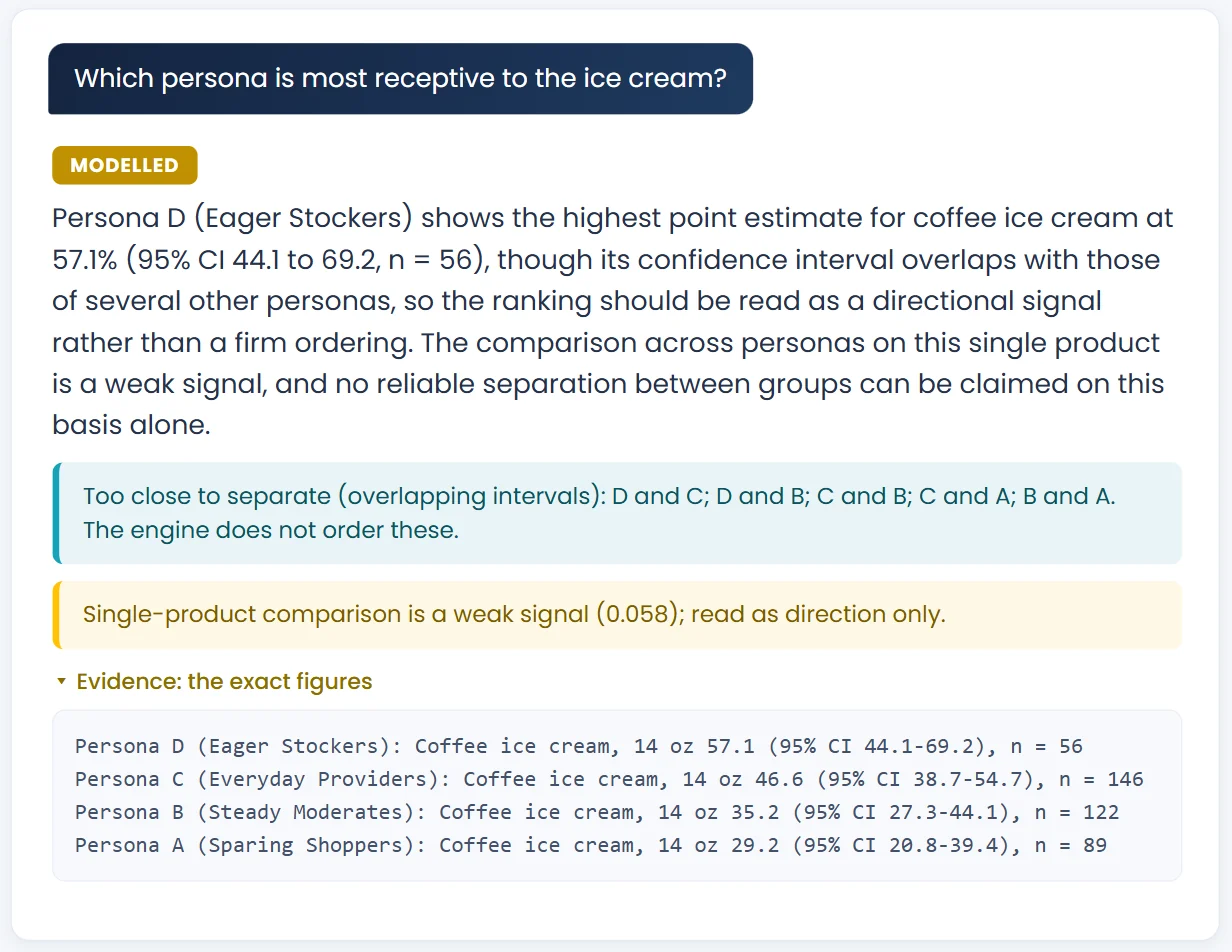
Line the personas up on the products or ideas you care about. When two groups are too close to call, the engine says so instead of picking one.
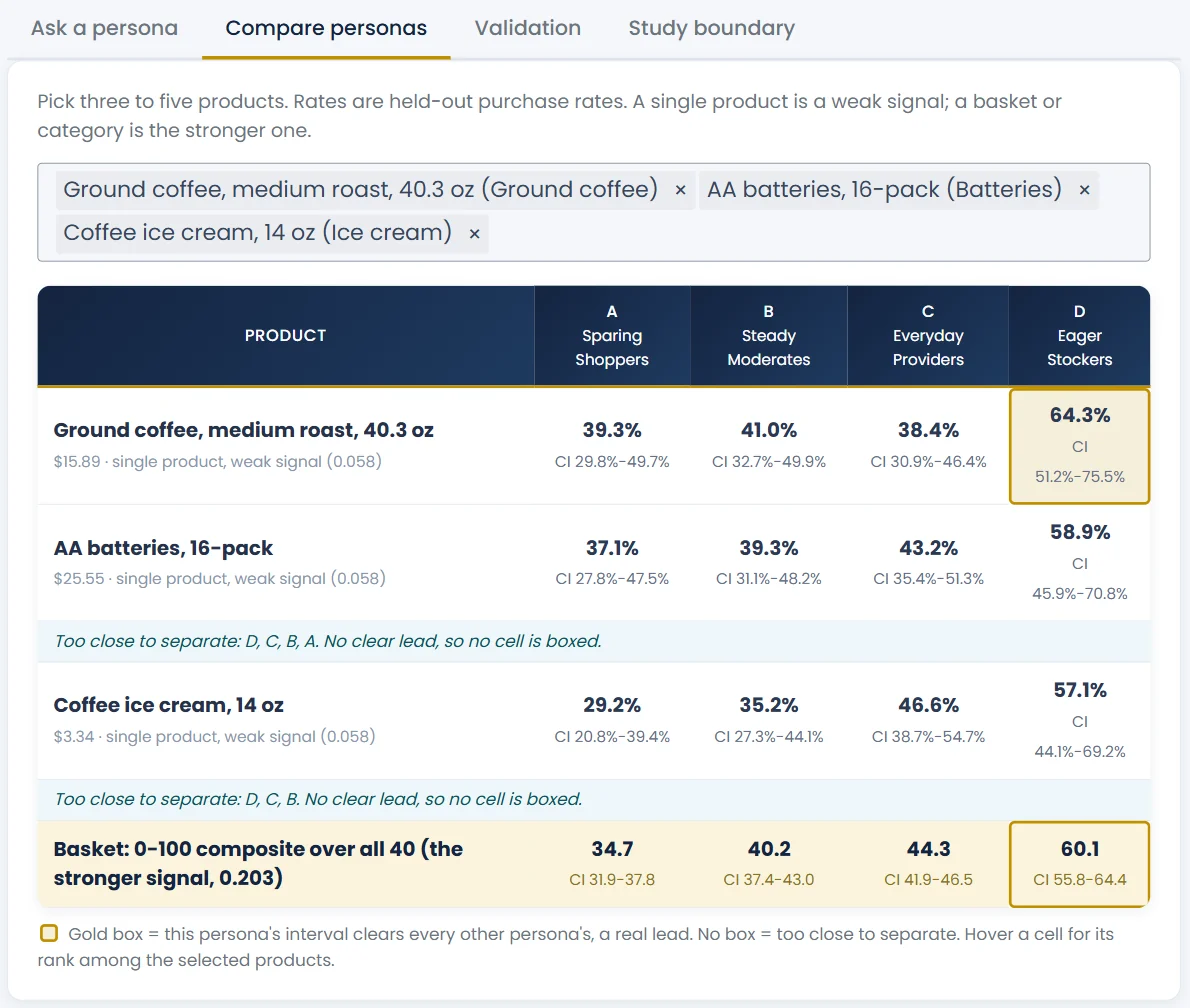
Every persona set comes with its validation: how well it held on people it had never seen, and how far apart the groups really are.
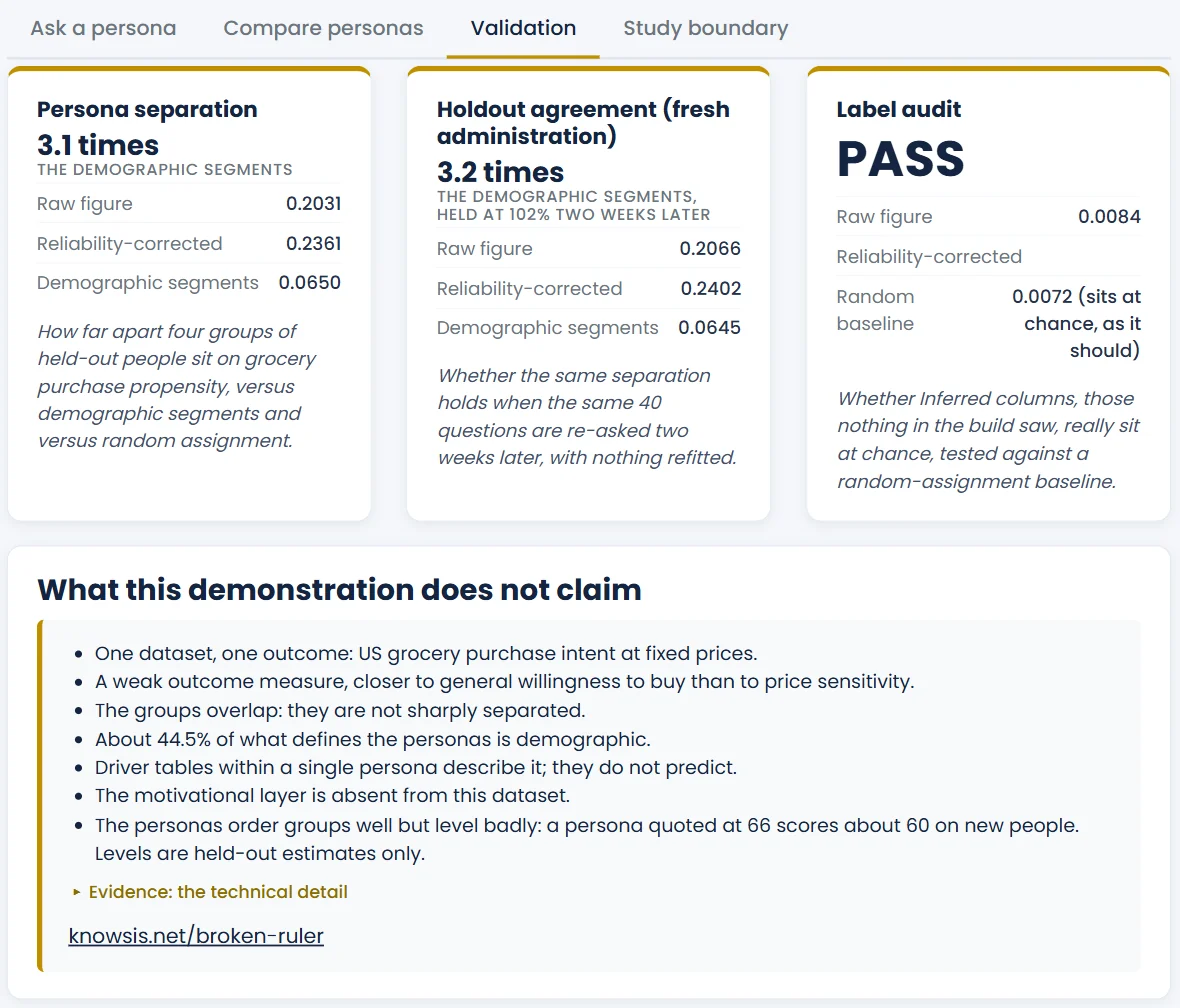
We validate every persona set before anyone relies on it. These figures come from our public validation on a published dataset, with the method written down before each test.
Each persona comes from what real people said in your survey, not from what an AI imagines customers are like.
We validate every persona set on people it has never seen. In our public validation, our personas told groups apart three times better than age, income and region, and still held two weeks later.
Every answer is labelled: read from the data, predicted from the data, or the engine's judgement. If your data cannot answer a question, it says so.
Every figure the engine shows is computed by the statistical analysis behind the personas, with its sample size and interval. The language model explains those figures in plain words. It cannot produce a number of its own, and when the data cannot answer, it says so.
Put five concepts or messages to each persona and see which lands best with which group, before you pay for a survey.
Ask what would move a group, and what would lose them.
Get a messaging brief for each persona, based on what actually drives that group.
Marketing, product and CX teams ask the same personas, so everyone works from the same answers.
The engine is the last of five steps. Three of them matter here.
We work out what drives the outcome you care about, such as loyalty or sales, for each person in your survey.
People who are moved by the same things go into the same persona, rather than being grouped by age or income.
Your team asks those personas questions in plain language, and every answer is labelled.
Where the questionnaire carries a short trade-off exercise of about three minutes, the Impulse Engine adds a motivational layer: not only what a persona values at rest but how it chooses when pushed. Our public validation ran without this layer. Retrofit projects run without it; Full build and Upgrade add it.
The Impulse EngineThe engine is good at telling you which option to back and which group to go after. It does not predict exact numbers, and it will tell you so. For a big decision, confirm the choice with real people.
We built four personas from 20,000 consumers in 20 European markets. Stakeholders across those markets can ask them how each group thinks about money, credit and risk.
Read the case studyWe rebuild it as personas and validate them. This is the quickest route.
We design a survey around the outcome you want to change, run it, and build the personas.
We make them answer questions and add the validation.
Whichever route you take, we train the people who will use it, and we judge the first three months by how often your team actually uses it.
What you need: survey data at the level of individual respondents, and an outcome worth predicting, such as loyalty, sales or retention.

The segment describes. The persona decides.
Greg Streatfield, writing in Greenbook, September 2026
You will speak to Greg Streatfield, founder of Knowsis, who has spent over twenty years building segmentations and driver models at TNS (now Kantar), Ogilvy and dunnhumby.
More on LinkedIn Knowsis on YouTube Read the Greenbook article
Last updated 23 September 2026
Still unsure whether personas are the right tool? Ask on a 30-minute call
A group of people defined by what drives the outcome you care about, rather than by who they are. We work out what moves that outcome for each person in your survey, then group together the people who are moved by the same things.
Because the groups are built on what drives them, each persona tells you how that group is likely to respond as well as what it looks like.
A digital twin claims to copy one person, and is judged on whether it gets that person right. A persona claims that a group of people tends to behave in a certain way, and is judged on whether the groups really differ when you test them on new people.
Synthetic respondents are survey answers generated by AI. A persona is a tested summary of real respondents. Only the persona claim can be checked before you spend money on the answer, which is why we build personas.
We validate every persona set before it is used: on people the model never saw, on how far apart the groups really are, and on how many answers come from the data rather than from judgement.
In our public validation on 2,058 US consumers, our personas told groups apart three times better than age, income and region, and held at full strength when the same people answered again two weeks later. The full validation is on the Broken Ruler page.
They are the labels on every answer. Measured means read straight from the survey data. Modelled means predicted from what drives the persona, and validated on people it had not seen. Inferred means the engine's judgement from the persona's profile, and is not grounded in measured data.
When the data cannot answer, it says so.
No. Use personas to choose between options, and use real people to confirm big decisions.
Personas are reliable at ranking groups, ideas and options, but they do not predict exact numbers: in our public validation, a persona scoring 66 on the people it was built from scored 60 on new people. Comparing a set of options gives a signal about three and a half times stronger than asking about one product on its own.
Survey data at the level of individual respondents, and an outcome worth predicting, such as loyalty, sales, retention or financial resilience. To see how people choose under pressure, add a trade-off exercise of about three minutes to the questionnaire.
If you already have a segmentation survey, we can rebuild it as personas. If not, we design one around the outcome you want to change.
No. The AI only ever sees the persona summaries that our analysis produces, never individual answers.
The Persona Engine can run on a locally hosted open-source model on Knowsis hardware in Cape Town, and we agree the model with each client to fit their data requirements.
Persona work is priced per project. The cost depends on the route, whether new fieldwork is needed, the market and the complexity of the work.
Rebuilding a survey you already have is the quickest route, because no new fieldwork is needed. Book a 30-minute call and we will tell you whether personas are the right tool for your decision, and what it would take.
Mostly retail, FMCG and financial services, for insights, marketing and CX teams internationally and in South Africa. Our persona work also covers African and emerging-market respondent data, where most synthetic panels have nothing to draw on.
Our flagship case is the Intrum European Consumer Payment Report: 20,000 consumers across 20 European markets, grouped into four personas that stakeholders in every market can question.
Book a 30-minute call. We will run the demo live, and tell you whether personas are the right tool for your decision.
Book a 30-minute callOr read the method first: the Predictive Persona Playbook, 19 pages, free